Articels
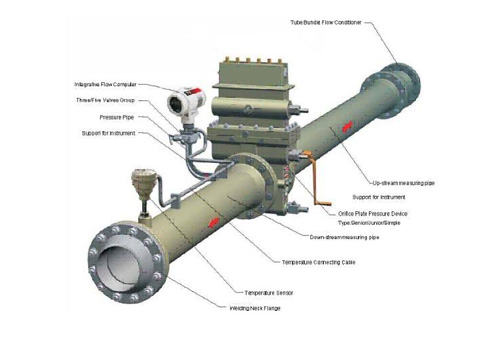
Custody Orifice Meter or Custody Transfer Orifice Meter
What is a Custody Orifice Meter?
A Custody Orifice Meter or Custody Transfer Orifice Meter is an orifice-based flow measurement system used for custody transfer applications, where the measured quantity of fluid is used for commercial transactions between two parties.
In simple terms:
When oil, gas, or other hydrocarbon products are transferred between companies, the payment is calculated based on the accurate measurement of the transferred quantity. Therefore, the metering system must provide high accuracy, reliability, traceability, and compliance with international standards.
A Custody Orifice Meter is one of the most widely used technologies for this purpose, especially in natural gas measurement systems.
Difference Between a Standard Orifice Meter and a Custody Orifice Meter
A standard orifice meter may be used for:
-
Process monitoring
-
Internal consumption measurement
-
Plant control applications
However, a Custody Orifice Meter must meet higher requirements:
✓ High measurement accuracy
✓ Traceability and documentation
✓ Calibration capability
✓ Auditability
✓ Compliance with industry standards
✓ Reliable operation over long periods
Main Components of a Custody Orifice Meter System
A typical Custody Orifice Meter system consists of:
Gas Flow
↓
Upstream Straight Length
↓
Orifice Plate
↓
DP Transmitter
↓
 Flow Computer
↓
 Custody Report
1. Orifice Plate
The orifice plate is the primary measuring element.
Common materials:
-
Stainless Steel 316 / 316L
-
Duplex Stainless Steel
-
Monel (for special applications)
Important characteristics:
-
Accurate bore diameter
-
Sharp upstream edge
-
Controlled thickness
-
Dimensional inspection report
-
Material certificate
The geometry of the orifice plate directly affects measurement accuracy.
2. Orifice Flange / Meter Run
Unlike a simple orifice installation, a custody system requires a properly designed meter run.
Important parameters:
-
Upstream straight length
-
Downstream straight length
-
Pipe internal diameter accuracy
-
Flow profile control
Because disturbances in the flow profile directly affect measurement accuracy.
3. Differential Pressure Transmitter
The DP transmitter measures the pressure difference across the orifice plate.
Example:
Upstream pressure:
80 bar
Downstream pressure:
75 bar
Differential pressure:
5 bar
The flow rate is calculated based on this pressure difference.
4. Pressure Transmitter
The pressure transmitter measures the actual line pressure.
This information is used for:
-
Pressure compensation
-
Density calculation
-
Volume correction
5. Temperature Transmitter
Gas volume changes with temperature.
The temperature transmitter provides data for:
-
Volume correction
-
Standard condition calculation
6. Flow Computer
The flow computer is the calculation unit of the custody system.
It receives:
-
Differential pressure
-
Static pressure
-
Temperature
-
Gas composition
-
Density data
and calculates the actual flow rate.
Measurement Principle
The operating principle is based on the relationship between pressure drop and flow velocity.
Simply:
Higher differential pressure = Higher flow rate
The basic relationship is:
Flow Rate ∝ √ΔP
However, custody calculations include several correction factors:
-
Discharge coefficient (Cd)
-
Expansion factor
-
Gas density
-
Pressure correction
-
Temperature correction
Main Standards
For natural gas custody measurement:
-
API MPMS Chapter 14.3
-
AGA Report No.3
are the main references for orifice metering systems.
Other API MPMS standards are also used for custody transfer applications in oil and gas industries.
Why Are Orifice Meters Still Widely Used?
Despite the availability of Coriolis and Ultrasonic meters, orifice meters remain popular because of:
✓ Simple design
✓ No moving parts
✓ Suitable for high pressure and high temperature applications
✓ Internationally accepted standards
✓ Easy maintenance
✓ Lower cost compared with some advanced technologies
Limitations of Orifice Meters
Main disadvantages:
✗ Permanent pressure loss
✗ Lower accuracy compared with Coriolis meters
✗ Requires sufficient straight pipe length
✗ Sensitive to dirty fluids and contamination
Custody Orifice Metering Skid
A complete custody orifice metering system is not only an orifice plate. It is a complete engineered package including:
-
Meter Run Design
-
Orifice Assembly
-
Differential Pressure Transmitter Integration
-
Pressure and Temperature Compensation
-
Flow Computer
-
Skid Fabrication
-
Calibration and Inspection Reports
The final product is commonly called a:
Custody Metering Skid
Strategic Opportunity for ARAMAK Smart Industry
For a company involved in instrumentation manufacturing, a Custody Orifice Metering System is a high-value product because it combines:
-
Orifice Plate Manufacturing
-
Flow Measurement Engineering
-
Skid Fabrication
-
Instrument Integration
-
Industrial Automation
This product can be positioned for applications in:
-
Oil & Gas Facilities
-
Petrochemical Plants
-
Refineries
-
Power Plants
-
Gas Transmission Systems
-
Industrial Metering Stations