Articels
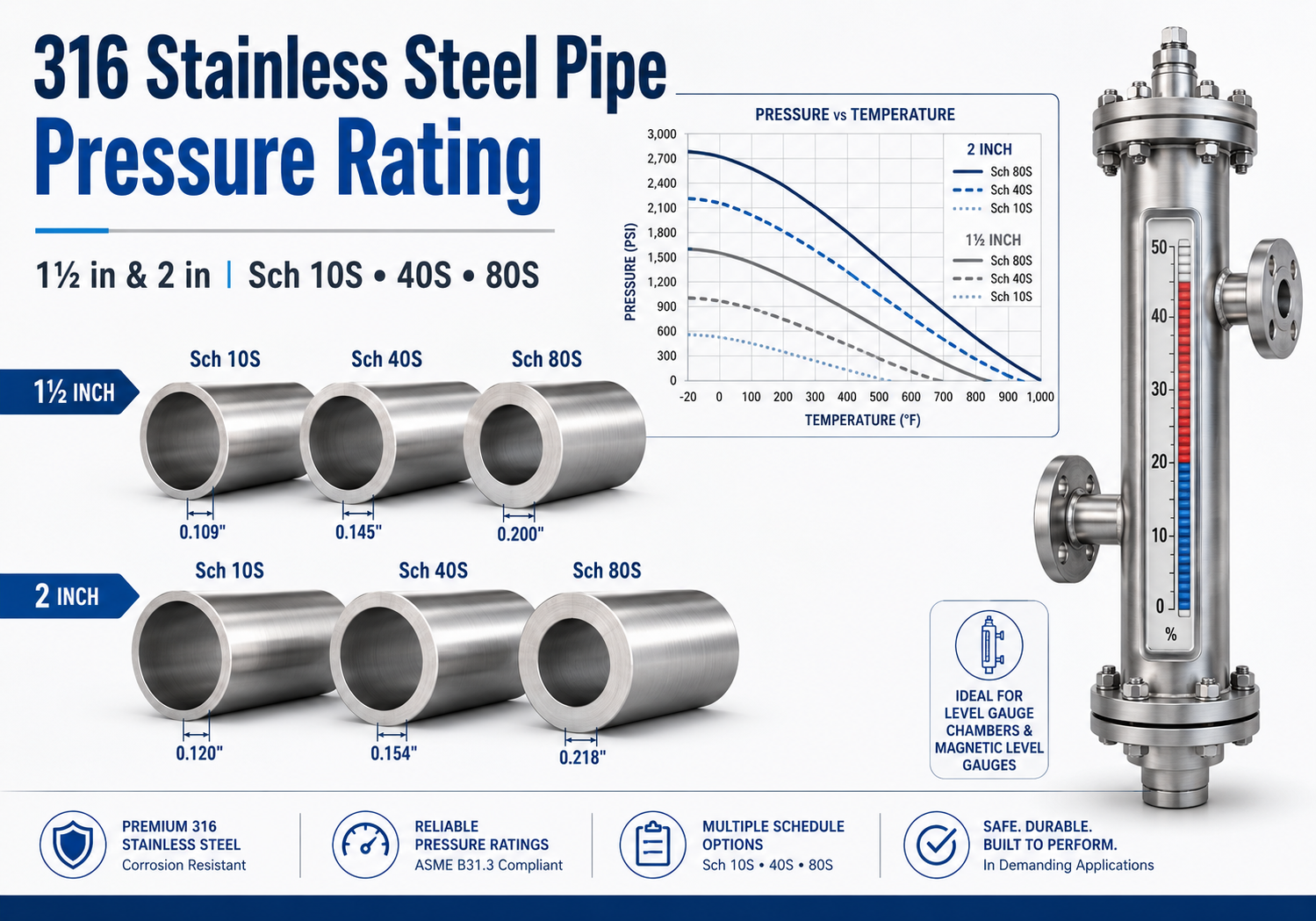
Pressure Rating of ASTM A312 TP316
Pressure Rating of ASTM A312 TP316 Stainless Steel Pipe at Different Temperatures
Comparison of Sch 10S, Sch 40S, and Sch 80S for Level Gauge Chambers
In the mechanical design of level measurement equipment such as Magnetic Level Gauges, Displacer Level Transmitters, Displacer Level Switches, and other side-mounted chamber instruments, selecting the correct chamber size and wall thickness is a critical engineering decision.
A common question among engineers is:
How much internal pressure can a 1½-inch or 2-inch stainless steel 316 pipe withstand at different temperatures and schedules?
The answer does not depend on pipe schedule alone. Several parameters influence the allowable pressure, including:
-
Design temperature
-
Pipe material grade
-
Outside diameter
-
Wall thickness
-
Corrosion allowance
-
Seamless or welded construction
-
Weld quality
-
Process connection rating
-
Flange class
-
Applicable design code
This article reviews ASTM A312 TP316 stainless steel seamless pipe in two commonly used chamber sizes:
NPS 1½" and NPS 2"
with three common stainless-steel schedules:
Schedule 10S, Schedule 40S, and Schedule 80S
Pipe Schedule vs Pressure Class
Before reviewing pressure values, it is important to distinguish two different engineering concepts.
Pipe Schedule defines the wall thickness of the pipe.
By contrast:
ASME Class 150, Class 300, Class 600, and other pressure classes define the pressure-temperature rating of components such as flanges.
Therefore, statements such as:
Sch 40 = Class 600
are technically incorrect.
A pipe may be capable of withstanding significantly more pressure than the flange connected to it. In such a case, the MAWP of the complete instrument will be limited by the flange or another weaker pressure-retaining component.
Pipe Dimensions Used in This Article
The nominal pipe dimensions are based on standard stainless-steel pipe dimensions according to ASME B36.19M.
| Pipe Size | Schedule | Outside Diameter | Wall Thickness | Approx. Inside Diameter |
|---|---|---|---|---|
| 1½" | Sch 10S | 48.26 mm | 2.77 mm | 42.72 mm |
| 1½" | Sch 40S | 48.26 mm | 3.68 mm | 40.89 mm |
| 1½" | Sch 80S | 48.26 mm | 5.08 mm | 38.10 mm |
| 2" | Sch 10S | 60.33 mm | 2.77 mm | 54.79 mm |
| 2" | Sch 40S | 60.33 mm | 3.91 mm | 52.50 mm |
| 2" | Sch 80S | 60.33 mm | 5.54 mm | 49.25 mm |
For a given nominal pipe size, the outside diameter remains constant while wall thickness increases with schedule and the inside diameter decreases.
For example, the wall thickness of a 2-inch stainless-steel pipe increases from approximately:
2.77 mm for Sch 10S
to:
5.54 mm for Sch 80S
Pressure Rating of 1½-Inch ASTM A312 TP316 Pipe
The following table shows the approximate allowable pressure capacity of the pipe body for ASTM A312 TP316 seamless pipe.
| Design Temperature | 1½" Sch 10S | 1½" Sch 40S | 1½" Sch 80S |
|---|---|---|---|
| 50°C | 146 bar | 197 bar | 280 bar |
| 100°C | 146 | 197 | 280 |
| 150°C | 146 | 197 | 280 |
| 200°C | 141 | 190 | 270 |
| 250°C | 132 | 179 | 254 |
| 300°C | 126 | 170 | 241 |
| 350°C | 121 | 163 | 231 |
| 400°C | 117 | 159 | 225 |
| 450°C | 114 | 154 | 219 |
| 500°C | 112 bar | 152 bar | 215 bar |
These values clearly show the significant effect of wall thickness on internal pressure capacity.
Pressure Rating of 2-Inch ASTM A312 TP316 Pipe
For NPS 2 pipe, the approximate pressure capacity is as follows:
| Design Temperature | 2" Sch 10S | 2" Sch 40S | 2" Sch 80S |
|---|---|---|---|
| 50°C | 116 bar | 166 bar | 241 bar |
| 100°C | 116 | 166 | 241 |
| 150°C | 116 | 166 | 241 |
| 200°C | 111 | 160 | 232 |
| 250°C | 105 | 150 | 218 |
| 300°C | 100 | 143 | 208 |
| 350°C | 95 | 137 | 199 |
| 400°C | 93 | 133 | 194 |
| 450°C | 90 | 130 | 189 |
| 500°C | 89 bar | 127 bar | 185 bar |
For example, a chamber made from:
2" Sch 40S ASTM A312 TP316
has a pipe-wall pressure capacity of approximately:
166 bar
at relatively low temperatures.
At 500°C, the same pipe is reduced to approximately:
127 bar
Why Can a 1½-Inch Pipe Withstand More Pressure Than a 2-Inch Pipe?
At first glance, a larger pipe may appear stronger, but this is not necessarily true for internal pressure design.
For approximately the same wall thickness and material, increasing the outside diameter increases circumferential or hoop stress.
Therefore:
1½" Sch 40S ≈ 197 bar
while:
2" Sch 40S ≈ 166 bar
under similar temperature conditions.
This is why schedule alone is not enough when discussing allowable pressure. The nominal pipe size must always be specified.
Pressure-Temperature Comparison
When all six pipe combinations are compared on one pressure-temperature chart, three important trends become clear:
-
Allowable pressure decreases as temperature increases.
-
Sch 80S provides the highest pressure capacity.
-
For the same schedule, 1½-inch pipe generally has a higher pressure capacity than 2-inch pipe.
Figure 1 – Pressure-Temperature Comparison of ASTM A312 TP316 Pipes
[Insert combined six-curve pressure-temperature chart here]
Comparison with ASME Class 150, 300, and 600
One of the most important considerations in Magnetic Level Gauge design is that the pipe pressure capacity must not be confused with the flange pressure class.
For ASTM A182 F316 flanges, the pressure-temperature rating varies according to ASME B16.5.
Typical values are shown below:
| Temperature | Class 150 | Class 300 | Class 600 |
|---|---|---|---|
| -29 to 38°C | 19.0 bar | 49.6 bar | 99.3 bar |
| 50°C | 18.4 | 48.1 | 96.2 |
| 100°C | 16.2 | 42.2 | 84.4 |
| 150°C | 14.8 | 38.5 | 77.0 |
| 200°C | 13.7 | 35.7 | 71.3 |
| 250°C | 12.1 | 33.4 | 66.8 |
| 300°C | 10.2 | 31.6 | 63.2 |
| 350°C | 8.4 | 30.3 | 60.7 |
| 400°C | 6.5 | 29.4 | 58.9 |
| 425°C | 5.5 | 29.1 | 58.3 |
This comparison leads to an important engineering conclusion.
Assume a chamber is made from:
2" Sch 40S ASTM A312 TP316
At 100°C, the pipe body can withstand approximately:
166 bar
However, an ASTM A182 F316 Class 600 flange at the same temperature is rated at approximately:
84.4 bar
Therefore, the complete instrument cannot automatically be assigned:
MAWP = 166 bar
because the flange becomes the limiting component before the pipe wall.
How Is the Actual MAWP of a Magnetic Level Gauge Determined?
The Maximum Allowable Working Pressure of a complete level gauge is not determined by the chamber pipe alone.
A simplified engineering definition is:
MAWP of Level Gauge = Lowest Allowable Pressure of All Pressure-Retaining Components
This includes:
Chamber Pipe → Branch Connection → Process Nozzle → Weld → Flange → Vent Connection → Drain Connection → Gasket → Closure
The lowest-rated component establishes the maximum allowable working pressure of the complete assembly.
Practical Example 1: Level Gauge with Sch 40S
Consider a Magnetic Level Gauge with the following specifications:
Chamber: 2" Sch 40S
Material: ASTM A312 TP316
Design Temperature: 100°C
Process Connection: ASTM A182 F316 Class 600
Approximate pipe capacity:
166 bar
Approximate Class 600 flange rating:
84.4 bar
Based only on these two components, the MAWP cannot exceed approximately:
84.4 bar
Other items such as welds, nozzles, vent, and drain connections must still be checked.
Practical Example 2: Does Increasing Schedule Always Increase MAWP?
Now assume the same level gauge is manufactured from:
2" Sch 80S TP316
The pipe capacity at 100°C increases to approximately:
241 bar
However, if the same Class 600 flange is used, its pressure-temperature rating remains:
84.4 bar
Therefore, increasing the chamber from Sch 40S to Sch 80S does not automatically increase the MAWP of the complete level gauge from 84 bar to 241 bar.
This demonstrates why selecting a heavier schedule solely to increase pressure rating is not always efficient.
Sch 80S may still be justified for other reasons, such as:
-
Higher mechanical rigidity
-
Local stress resistance
-
Nozzle loads
-
Corrosion allowance
-
Impact resistance
-
Additional design margin
Is Sch 10S Suitable for Magnetic Level Gauge Chambers?
From a purely internal pressure standpoint, Sch 10S can provide substantial pressure capacity.
For example:
2" Sch 10S TP316 at low temperature ≈ 116 bar
However, chamber selection should not be based only on membrane pressure stress.
A Magnetic Level Gauge chamber is often relatively long and may include:
-
Welded process nozzles
-
Vent and drain connections
-
Supports
-
Indicators
-
Float assemblies
-
External mechanical loads
Additional factors include:
-
Local stress
-
Vibration
-
Transportation loads
-
Handling loads
-
Hydrostatic testing
-
Mechanical stiffness
For this reason, Sch 40S is often a more balanced choice for many industrial level gauge applications.
When Is Sch 80S More Appropriate?
Sch 80S can be a suitable option for:
-
Higher design pressures
-
Heavy-duty applications
-
High nozzle loading
-
High mechanical stiffness requirements
-
Greater corrosion allowance
-
More demanding service conditions
At approximately 100°C:
| Pipe | Pipe Pressure Capacity |
|---|---|
| 1½" Sch 10S | 146 bar |
| 1½" Sch 40S | 197 bar |
| 1½" Sch 80S | 280 bar |
| 2" Sch 10S | 116 bar |
| 2" Sch 40S | 166 bar |
| 2" Sch 80S | 241 bar |
However, all other pressure-retaining components must still be checked.
Is a Higher Schedule Always Better?
No.
Increasing pipe schedule also has disadvantages:
-
Higher chamber weight
-
Higher material cost
-
More difficult machining
-
More welding effort
-
Smaller internal diameter
-
Reduced available space for the float
In a Magnetic Level Gauge, the reduced inside diameter may directly affect float sizing and float movement.
The final engineering selection should balance:
Pressure Capacity + Mechanical Strength + Float Diameter + Weight + Cost + Availability
Effect of Temperature on Stainless Steel 316 Pressure Capacity
The allowable pressure is not constant over temperature.
As the design temperature increases, the allowable stress of the material changes, resulting in a reduction in pressure capacity.
For example, for a 2" Sch 40S pipe:
At approximately 100°C:
≈166 bar
At 300°C:
≈143 bar
At 500°C:
≈127 bar
Therefore, a level gauge suitable for a certain pressure at 100°C cannot automatically be assigned the same pressure rating at 400°C or 500°C.
Is Hydrotest Pressure the Same as MAWP?
No.
MAWP – Maximum Allowable Working Pressure
defines the maximum pressure the equipment can safely withstand at the specified design temperature.
Hydrostatic Test Pressure
is a temporary test pressure applied under controlled test conditions.
Therefore:
Hydrotest Pressure = 150 bar
does not mean:
MAWP = 150 bar
Hydrotest pressure must be determined according to the applicable design code, design pressure, test temperature, and project specification.
TP316 vs TP316L
Another important consideration is the exact material grade.
ASTM A312:
TP316
and:
TP316L
are similar but not identical materials.
Likewise:
ASTM A182 F316
and:
ASTM A182 F316L
should not automatically be assumed to have identical pressure-temperature limits under all conditions.
The actual material grade stated on the Material Test Certificate should always be used in final design calculations.
Conclusion
The selection of a Magnetic Level Gauge chamber should not be based only on experience or a generic pipe pressure table.
For ASTM A312 TP316 seamless stainless-steel pipe, approximate low-temperature pipe-wall pressure capacities are:
| Size | Sch 10S | Sch 40S | Sch 80S |
|---|---|---|---|
| 1½" | 146 bar | 197 bar | 280 bar |
| 2" | 116 bar | 166 bar | 241 bar |
However, these values are not the final MAWP of the level gauge.
For example, an ASTM A182 F316 Class 600 flange at 100°C is rated at approximately 84.4 bar. Therefore, in a level gauge using a 2" Sch 40S chamber and Class 600 process connections, the flange may become the limiting component before the chamber pipe.
The final MAWP should always be established by evaluating all pressure-retaining components of the assembly.
Frequently Asked Questions
How much pressure can a 2-inch Sch 40 stainless steel 316 pipe withstand?
For ASTM A312 TP316 seamless pipe, the approximate pipe-wall pressure capacity of 2" Sch 40S is around 166 bar at relatively low temperatures. This is not the MAWP of the complete equipment.
How much pressure can a 2-inch Sch 80 stainless steel 316 pipe withstand?
Under similar conditions, 2" Sch 80S ASTM A312 TP316 seamless pipe has an approximate pipe-wall pressure capacity of 241 bar at low temperature.
Is Sch 40 suitable for a Magnetic Level Gauge chamber?
For many industrial services, 2" Sch 40S provides a practical balance between pressure capability, mechanical strength, weight, cost, and internal diameter. Final selection should still be based on design pressure, temperature, corrosion allowance, nozzle loads, and component ratings.
What is the difference between Sch 40 and Class 600?
Sch 40 defines pipe wall thickness. Class 600 defines a pressure-temperature rating for components such as flanges. They are completely different engineering classifications.
Can pipe pressure capacity be used as the level gauge MAWP?
No. The MAWP of the complete level gauge must be based on the lowest-rated pressure-retaining component.
Which is better for a high-pressure level gauge, Sch 40 or Sch 80?
Sch 80 provides higher pipe-wall pressure capacity and mechanical stiffness, but it should only be selected when justified by design pressure, local stress, corrosion allowance, or mechanical loading.
Does pressure rating decrease with temperature?
Yes. As temperature increases, allowable material stress generally decreases, resulting in lower allowable internal pressure.
Are TP316 and TP316L pressure ratings identical?
Not necessarily. The exact material grade and applicable code must be checked during final engineering design.
Technical Disclaimer
The information provided in this article is intended for engineering guidance and preliminary selection only and should not replace project-specific mechanical design calculations.
The final pressure rating of any pressure-retaining instrument should be determined using the applicable design code, actual material certificates, design temperature, corrosion allowance, welding configuration, nozzle design, process connection rating, and project specifications.
For high-pressure level gauges and pressure equipment, final MAWP should be reviewed and approved by a qualified mechanical engineer.
ARAMAK Smart Industry
Design and Manufacturing of Level and Flow Measurement Equipment
Magnetic Level Gauges | Sight Glass Level Gauges | Displacer Level Instruments | Differential Pressure Flow Elements | Metering Systems